
The following is an article by Wendell Koning, M.Sc., Biol, who is a retired Limnologist/Water Quality Specialist who worked for the Alberta provincial Department of the Environment from 1999 to 2020. Much of his work involved rivers in the Oldman Basin. He was a colleague of the provincial scientists identified in this article.
To: Crowsnest Headwaters Substack followers
There was a pro-Coal article on the May 16, 2026 Opinion page of the Calgary Herald, entitled: Many Crowsnest Pass residents back the coal mine in their backyard, by Carmen Linderman, who is president of Citizens Supportive of Crowsnest Coal. Linderman provides a well-written article in favour of the proposed coal mine promoted by Northback Holdings, a coal mining company owned by the Australian billionaire Gina Rinehart.
I do however disagree with Linderman’s first point where he notes that the Municipal District (MD) of Crowsnest Pass voted 72% in favour of the Northback proposed mine at Grassy Mountain. What Linderman did not include, though, is that the proposed mine would not be situated in the Municipality of Crowsnest Pass; in actual fact, it is located mostly outside of their municipality, in the MD of Ranchlands. It is easier to vote in favour of a potentially polluting industrial project if it’s not in your own municipality - and the MD of Ranchland has come out opposed to the proposed mine. One more point in this regard – there are two creeks draining from the proposed open-pit Grassy Mountain mining site, namely Blairmore Creek, which discharges into the Crowsnest River at Blairmore, and Gold Creek still further to the east. And so there is a significant geographic part of the MD of Crowsnest Pass that is upstream, upwind of any air and water impacts from the proposed mine. Again, when negative impacts occur downstream, downwind of where one lives, it does make it easier to be pro-coal.
A second point Linderman made: “We voted for an economic boost – an anchor industry and the jobs that come with it.” I get that, good-paying jobs, year-round employment, perhaps new schools and hospitals, and roads repaved are activities we all want in our communities. But let’s listen to communities further downstream in the same watershed, for example, in the city of Lethbridge. The Calgary Herald newspaper of March 1, 2025, had the following headline: “Lethbridge council confirms it opposes coal mine projects”. In the article, the Mayor and City Council express concern about impacts, namely from selenium on the southern Alberta economy, specifically on the extensive irrigation systems downstream, where contaminated water from mine effluent, could impact the irrigation water and “the reputation of our agri-food processing hubs”. These city residents are the downstream recipients of any new Grassy Mountain coal mine, and in their opinion, it’s not worth the risk. The agriculture industry is sustainable, extremely high value, provides many jobs, and will continue for the next 100 years and beyond, whereas a new or reopened coal mine in the Crowsnest Pass will exist for 25-35 years, followed by perhaps 50-100 years of polluted waterways and toxic airborne dust. If I lived in the Oldman watershed, I would favour the argument from the City of Lethbridge. As well, if majority opinion should rule (another point that Linderman makes), then, very likely, based on past voting results, the Grassy Mountain proposed mine would be voted down by most of the residents in the Oldman basin. Let all the residents in the affected basin decide!
Regarding potential environmental impacts, Linderman suggests we can rely on the AER (Alberta Energy Regulator) oversight of the Northback coal mine application, since “they employ subject matter experts who have studied these projects for years”. This sounds very reasonable. In fact, Linderman must know this: the AER and the federal Ministry of Environment and Climate Change rejected an application for a coal mine at Grassy Mountain in 2021 as it was considered too risky from an environmental perspective. It is the currently UCP government that is now attempting to get around the results of the environmental review. The Alberta Energy Regulator with “all it’s subject matter experts” indeed rejected the Grassy Mountain coal mine application.
I would suggest that one also look to the provincial government watershed scientists for advice. Alberta Environment and Protected Areas is blessed with the presence of excellent scientists who have taken field samples, assessed, and reported on the impacts of coal mines on Alberta rivers in the Oldman, Red Deer, North Saskatchewan, and Athabasca basins. Their role is to focus on the science, just the science, no need to attempt to balance the environment and industry, no need to consider political priorities. Starting with Richard Casey in the 1990s, and through the work of Drs. Cooke, Emmerton, Drevnick, Donahue, and Kerr (2020-2025) you can find their methods and conclusions reported in readily available international peer-reviewed journals. Our provincial Environment department has done a stellar job with these scientific studies and reporting. They have shown, using real data, that Alberta’s coal mines are negatively impacted our waterways, with selenium being the key toxic pollutant. Selenium is an essential element for humans and other animals, but at higher concentrations it is toxic to fish, terrestrial wildlife, farm and range animals, and to humans. The Elk River through Fernie, BC, for example, is too contaminated with selenium for use as a potable water supply due to upstream coal mining activity. This is real, and this impacts humans. Again, I suggest we listen to the Government of Alberta (GOA) scientists; they have been hired by GOA to provide this clear, unbiased knowledge. Alas, they are currently not allowed to speak publicly about what they have written, the reason unknown. But their reports speak for themselves with their final conclusions being: “there are negative impacts, and there will be more if new coal mines are approved” (Cooke et al, 2025). Selenium values in many of the coal mine affected lakes and streams that they sampled were well above the provincial guidelines for protection of aquatic life. They are reporting real data, real impacts, proven impacts on aquatic organisms and potential downstream impacts from range cattle to human consumption.
As well as GOA scientists working for the provincial Department of the Environment, one can refer to the work and reporting from Dr. Ross McKenzie, a former agronomy research scientist with the provincial Department of Agriculture. McKenzie worked out of the GOA Alberta Agriculture office in Lethbridge for 38 years. His opinions are expressed in his recent articles published in the newsletter, Grainviews (January 22 and March 31, 2025). In his professional opinion, selenium could be an issue for irrigation farmers in southern Alberta and further downstream into southern Saskatchewan. According to McKenzie, selenium accumulates in irrigated soil and can be taken up by crops, which selectively store it in seeds rather than in leaves or stems. McKenzie’s concern is potentially contaminated crops, contaminated feed stock for livestock and contaminated livestock going to market. As well, rangelands downwind of the proposed Grassy Mountain mine would likely also be affected by fugitive coal dust in an area of the province well known for high velocity chinook winds.
A final point that Linderman makes is that coal mines today use treatment methods designed to meet guidelines that protect fish, downstream water users, and people who drink the water. I respectfully disagree. The new treatment methods can, in laboratory settings and controlled field trials, remove 95-99 percent of selenium, which is impressive. But the end results are still above the environmental guidelines. My understanding here is based on what I read in pro-Coal literature. For example, in a March 25, 2025, Technical Memorandum from an Ontario-based consulting firm, the report states that a mine in northeast BC (Conuma Brule Mine) is removing 94% of selenium from a waste stream, reducing it from 200 micrograms per litre to 20 micrograms per litre. This is impressive, but the BC guideline for protection of aquatic life (for fish species, etc.) is 1 microgram per litre and for source drinking water, 10 micrograms per litre. The treatment technologies are improving, but they are still not good enough. The same article states that “selection of appropriate treatment methods depends on criteria such as cost, climate conditions, resource availability, and energy requirements.” Note that the first item in the sentence is the issue of cost. Just because there are more effective treatment technologies, some may be cost-prohibitive and therefore a company such as Northback may protest a requirement to use these best available technologies (economically unviable) and instead use inferior methods that would cost less and, alas, pollute more.
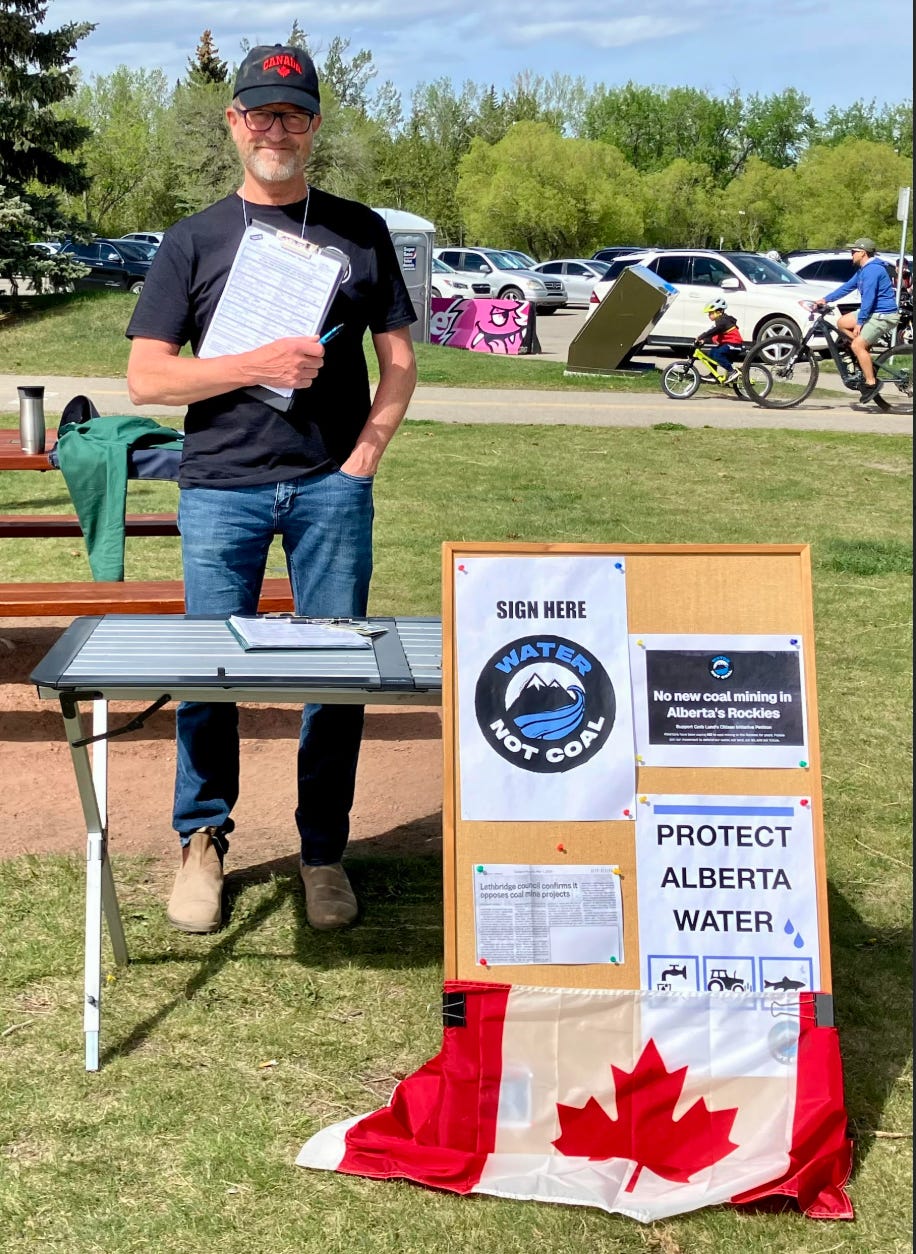
This is a difficult issue with many contrasting, often impassioned opinions, all of which should be respected. Linderman provided a very reasonable opinion based on his living in the Crowsnest Pass and the beneficial employment a new mine would provide. Lethbridge City Council expresses the opposite opinion – do not kill the agricultural industry in southern Alberta, which, in contrast to the proposed Northback mine, is much larger and far more sustainable than coal. I hope that the “Water not Coal” initiative, led by singer Corb Lund, is successful in obtaining sufficient signatures by June 10th to motivate the current UCP government to include this in its decision-making and solicit feedback; let the people of Alberta decide.
The question is this; "should I really be dumping my garbage in my neighbor's back yard?"
Excellent explanation of the BS of the mine supporters.