
Lorne Fitch, P. Biol.
If you don’t know where you are, says Wendell Berry, the Kentucky farmer/philosopher, you don’t know who you are. My father, a farmer, was no philosopher, but based on the amount of time he spent walking in the fields of the farm, cultivating those fields, looking for weed patches, inspecting the cattle herd, and fixing fence, he knew the place. Because he knew where he was I suspect he knew who he was. Whether he was satisfied with that, I don’t know.
My sense is that he and my mother, grounded as they were in the farm, had no great aspirations to expand, innovate, be more efficient, or increase farm outputs. My older brother and I, not being as substantially grounded, chaffed at the failure to employ technological advancements to grow more, grow it better, ease the workload, and increase profits.
I moved away from farming to construction, work in the oil patch, and in the timber industry. None of the off-farm jobs, or the moves required, contributed to understanding where I was, only to the incessant desire to acquire the bright, shiny things of a wage slave. It did not contribute to an understanding of who I was.
Throughout the often mindless work of pipeline construction, oilfield maintenance, logging, and sawmill work were the equally mindless conversations with co-workers, equally adrift from place. Watching bulldozers churn through a wetland, spreading gravel on top of an oil spill to disguise the impact, and watching the sawdust and slabs from a sawmill float down a small stream, the conversations didn’t deviate from the next party and the relative merits of big block Fords, Dodges, or Chevys.
Although I left the farm, in some unconscious way, parts of the farm never left me. What stuck were the memories of intact aspen forests, the wetlands, and the wildlife experiences of my childhood. These occasionally beckoned to me amid the callous, calculating, and numbingly destructive tendencies of resource extraction enterprises.
The scales began to fall from my eyes as I planted trees on logging clear-cuts on weekends off from the sawmill. Negotiating a clear-cut, with a sack of tree seedlings and a dibble stick to plant them, was akin to traversing a First World War battlefield. Amongst our tree planting crew no one but me seemed to see the extent of forest devastation and the puny, ineffectual efforts of establishing anything resembling a functioning forest on that logged over, churned up wasteland. I saw where I was and I was not pleased with the place.
I suppose returning to university after a break in the work world started the transition to being more mindful. However it was breaking into the field of ecology through a summer job with Alberta Fish and Wildlife that cemented the deal. I arrived to a tribe of people who both knew where they were and who they were, because they were grounded in place.
My biologist colleagues belonged to a biotic community that included fish, wildlife, and their habitats. Moreover, these were people who viewed the landscape and its attributes, not as fungible units for economic exploitation, but as places to live with intact, functioning ecological features. That’s not to suggest they were born in place, but moved, stayed, and got to know place.
This may not be the norm anymore. Increased mobility, an increasingly urban population, living in more artificial environments, and losing connections with natural, wild places does not bind people to place effectively. This also enhances the sense we can endlessly tinker with and change place, to suit and profit ourselves, our life styles, rather than melding ourselves to place.
Nowhere becomes place until experiences accumulate as stories, songs, scars, and ultimately a history of sharing that bond us to that place. Maybe it starts with a family picnic on the edge of a clear stream. Then kids and their friends start to fish, camp, and go for hikes. Birds call out for identification and the sight of a coyote, a deer, or a squirrel starts a pathway to understanding biodiversity. A fire, a flood, or a drought impresses with ecosystem chaos and complexity. Grizzly tracks in the mud and the phantom-like wisp of a cougar underscore trophic levels as well as causing the hair on the back of the neck to rise on reflection humans aren’t often the dominant force.
This isn’t just about recreational bonding. It includes living off the land in ways that are in synchrony with the natural system. Ranching is an example of understanding, implicitly, the attributes and the limits of place, of a big place. Regenerative agriculture that doesn’t mine the soil but adds, maybe restores ecological value to place is one of also understanding the intricate processes at play. At smaller scales the practice of permaculture, of mimicking nature, is wedded to place. All these economic endeavours, large and small, require a hands-on approach, with boots on the ground. This is fundamentally a process of bonding with and belonging to place.
The hubris of technology blinds us to an essential wisdom about place and what places can teach us. About 2060 years before present Job, the man of Ur, passed on this ecological insight:
. . . ask now the beasts, and they shall teach thee; and the fowls of the air, and they shall tell thee:
Or speak to the earth, and it shall teach thee; and the fishes of the sea shall declare unto thee.
The places that start to forge those associations rise in prominence and form a heightened sense of awareness of the risks to these landscapes and creatures. Awareness also grows that everyone does not share this perspective of place. Some, perhaps many will still view place through a lens of economic development. They know where they want to be, and the pathway is through the place you want to stay as it is.
Arguments will rage over the need to mine, cut, extract, plow up, and otherwise plant a human footprint. Invoked to support the economic rationale will be the tantalizing baubles of sustainable development, rents and royalties, increased tax revenue, more public services, employment, balance, mitigation, and a host of other mind-numbing excuses why a place shouldn’t be left alone.
If these landscapes succumb to the ephemeral promise of development, they have a strong likelihood of never again being seen as place. Logging clear-cuts, coal strip mines, irrigated fields, urban sprawl, oil fields and landscapes laced with roads, power lines, and pipelines no longer feel like place. They will have lost the tangible aspects as well as the hard to categorize features to which we can bond.
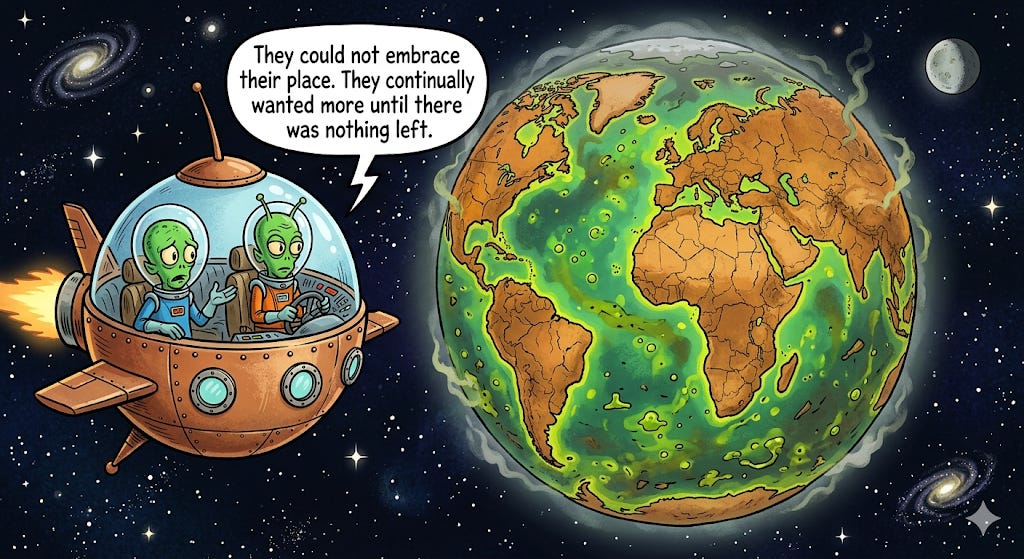
As these places shrink and become metastasized we need to look hard around us. Indifference to, or contemptuous of committing to place, always looking beyond at the next big play, to something better, and constantly wanting change, many people have never stayed in one place long enough to learn it. To them a place is only an address, a worksite, and leaving it damaged, used up and fouled is no hardship.
This tendency of restlessness, of a frontier mentality, will continue, certainly for a few more generations before we grow up, understand the limits of place, and acquire the type of knowing that involves the senses, science, memory, history, and belonging. Then, maybe we will be mature enough to live on a piece of the Earth without destroying it.
The late John Dormaar, a soil scientist, postulated that a template for belonging would have been with pre-contact Aboriginal Peoples, like the Piikani and Kainai. He thought they didn’t just live on the land, they were literally of the land, with close, direct, and intimate connections primarily through diet. Landscape attributes and elements of prairie grasses, wildlife, water, and maybe a hint of star dust, subject to endless cycling, would have constituted who they were and where they were from.
In the interim, we need to do many things. First, we need to hold up a mirror to reflect the reality of who and where we are, not the illusion. For the hard of hearing on their destructive economic pathway we must learn to shout. Most importantly, the stickers in our society need to be encouraged, the ones who want to stay and develop a knowledge of place. They are the ones who have the potential to develop a sense of belonging, to accept and invest in place, and to create a legacy of doing so.
If we persist, a segment of Alberta society will begin to know both where and who they are and this will sow the seeds for others to intelligently belong to a place.
Lorne Fitch is a Professional Biologist, a retired Fish and Wildlife Biologist and a former Adjunct Professor with the University of Calgary. He is the author of Streams of Consequence, Travels Up the Creek, and Conservation Confidential.
Another most meaningful piece of writing from your “place”, your heart, Lorne.
Thank-you for your words, I needed them in these strange times!
Thank you