
Lorne Fitch, P. Biol.
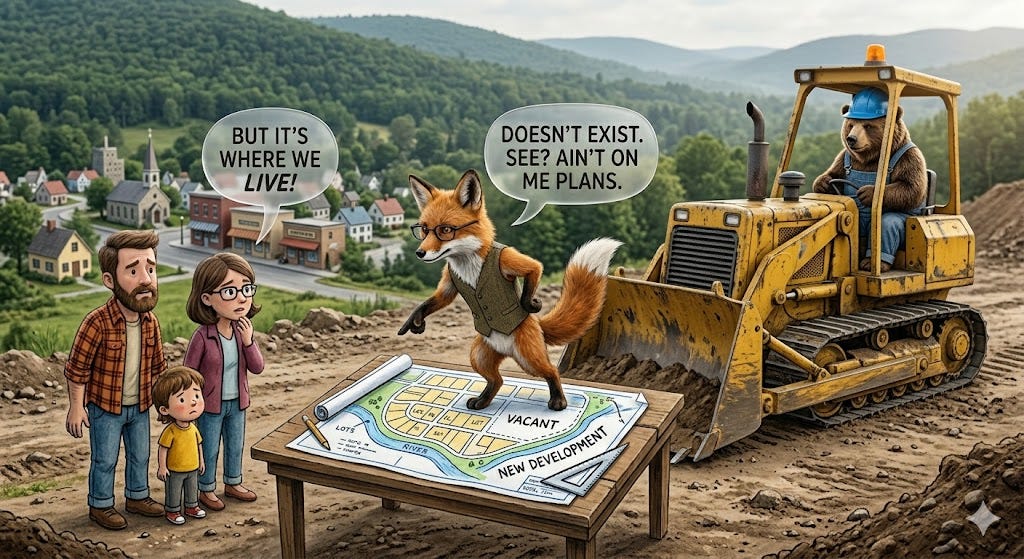
When I first read how the Indian state of Tamil Nadu made a stream disappear I thought it was an elaborate joke by author Robert Macfarlane in Is a River Alive? Instead it was a carefully contrived and orchestrated mapping exercise to eliminate the existence of Ennore Creek. Why the cartographic ruse?
A national directive from the Indian government compelled state governments to plan for management of coastlines to protect mangrove forests and other sensitive ecological features. The problem faced by planners was the watershed of Ennore Creek, a backwater of the Kosasthalaiyar River, was already the site of the area’s heaviest industries—petrochemical refineries, coal-fired power stations, and chemical factories. The stream provided a conduit for the discharge of waste heat and toxic by-products from these industries.
This was very inconvenient, and was contrary to the directives. State authorities came up with a bold, simple plan. Erase the stream’s existence. The new Coastal Zone Management Plan, at least what appeared on the map had none of the mangrove forest, none of the sensitive ecological features and most of the stream wiped out by the map makers art.
Without its existence on a planning map, the stream had no legislative protection—well, how can you protect something that doesn’t exist? Without protection, the stream, the mangrove forests, salt pans, and sand dunes have become a sump and a dump for all the industries’ wastes.
Only in India you ask? Hardly! Such conjuring acts of making landscape pieces disappear are also a phenomena of Alberta and likely the envy of David Copperfield.
Every Alberta city, and many towns have ghost streams, creeks that have been channelized, diverted, piped, and otherwise buried. They have lost their names, their identities, and their functions. Even the memory of them has evaporated. In erasing them from the landscape it allowed urban development to proceed unhindered.
Even outside of urban boundaries small streams, once the source of fish for settlers, have disappeared through straightening, cultivation, and drainage of their wetland sources. If they once had a name this is long forgotten and these intermittent channels are not even thought of again as streams.
We have a history of making landscape pieces disappear. In their disappearance is the liberation from the nagging of conscience. Major portions of the grassland, the aspen parkland, and the boreal fringe disappeared with a grub hoe, the caterpillar dozer blade, and the steel plow. To transform them into the crop fields of today took an immense physical effort and a mental one, to ignore and forget what once existed.
Along with streams and wetlands and native grasses what also disappeared were the creatures that made the landscape whole—bison, sage-grouse, pinnated grouse, and swift fox. More recently a legion of others are trending the same way. Like ignoring the homeless or Aboriginal Peoples, who then seem to fade, one by one into the background, out of sight, out of mind, beyond caring and compassion, once gone this opens up opportunities for unfettered and guilt-free economic development. This requires some pre-emptive strategy like that employed by the planners in Tamil Nadu.
We can see this at play in recent coal mining proposals, continuing tar sands development, and existing petroleum footprints. If the toxic runoff kills the fish, the poisonous emissions impact a few downwind people, and make our climate every so more erratic and dangerous, then a little more can’t really do any greater harm. Rather than deal with the issues, up front, some illusionist fog is necessary. This is reminiscent of the Dead Parrot sketch, a Monty Python classic, where the argument goes the parrot isn’t dead, it is merely resting, or stunned.
Once the impacts are evident and probably irreversible why apply all the now unnecessary and redundant protective legislation? Let’s tinker with and fudge the numbers for environmental limits. Even if the river is dead, the air redolent with fumes and green house gases, and missing are a mountain or two, muskegs, forests, and wetlands, we’ll still be fully compliant. Who will ever notice, or care?
Creatures like caribou, Athabasca rainbow trout, arctic grayling, and bull trout are really inconvenient in a planning process where resource extraction is prioritized. If they are made to disappear through the chicanery of corporate-driven land-use planning, as has been attempted in the Upper Smoky, it simplifies the process. If they no longer exist because they’ve been painted out of the picture, well, the species recovery plans, the federal legislation, the elaborate charade of caring are all moot, are they not? Corporations can then concentrate on logging, drilling, mining, and the other ways to make a landscape pay dividends to shareholders.
Even without being perceived, the economic illusionists can change things. This process moves with stealth and is initially invisible, dissolving the usual ways of seeing and allows distortions to creep in, quietly, surreptitiously, like fog draping a forest. And then the forest isn’t there.
There is magic in this sleight of hand version of land-use planning, a skillful deception that might fool some. But like Ennore Creek in India it only works if you only look at the plan, not the reality of what happens on the ground.
Lorne Fitch is a Professional Biologist, a retired Fish and Wildlife Biologist and a former Adjunct Professor with the University of Calgary. He is the author of Streams of Consequence, Travels Up the Creek, and Conservation Confidential.
Our government willfully allows their “facts” to be presented by the forces who are at fault. What b.s.! But they’re noted for it. Our next election is far away but it is coming. Hopefully whatever is left of our province is worth saving.
Thank you Lorne Fitch. Your ability to call out uncomfortable truths, highlight systemic erasure, and make visible what is often ignored is both brave and deeply moving. I deeply appreciate how you pay attention not just to what is lost, but to the politics and deliberate decisions. That is not an easy road to go down.