
Lorne Fitch, P. Biol.
The ritual of remembering can falter because there are few left with whom to remember. My friend and mentor Carl Hunt and I often commiserate over the decline in our native trout populations. I appreciate that his memory stretches back further than mine. Those memories bring back life to things that no longer exist.
Early in my career he and I inspected an Alberta Transportation channelization project on Alford Creek, west of Caroline. Alford Creek was one of those unique spring creeks, like the North Raven, that is fed by shallow groundwater flows from the Clearwater River. As we stood on an eroding stream bank, looking down an arrow straight stream channel with bulldozed piles of willows on either side, Carl reflected on fishing the stream years before. The anger in his voice was palpable, describing the memory of a meandering, willow-shrouded trout stream filled with big trout that was now a ditch.
Recently Carl reflected on his experience over the last five decades in the northern foothills, based out of Edson: “Everybody has forgotten the science provided by Tri Creeks about the impacts of logging where Eunice Creek was one of the main spawning streams in the upper McLeod River, second only to McKenzie Creek. Athabasca rainbow trout used to inhabit Wolf Creek and Carrot Creek and the headwaters of the Lobstick River, east of Edson along with Arctic grayling. The Pembina River was the southern range of the grayling, and sadly their last habitat was appropriately named Dismal Creek. The Species at Risk Act doesn’t even recognize the habitats where these species have disappeared, and even biologists seem to have forgotten how much has been permanently lost.”
Some losses are historical in nature and mourning them is more a detached academic exercise.
In Forty Years in Canada, Sam Steele, the famous member of the NWMP, reflected on constructing Fort Saskatchewan in the spring of 1875. This was a North West Mounted Police post east of Edmonton, on the banks of the North Saskatchewan River. One of the memories was— “Our food at this time consisted of pemmican and mountain trout. The smallest trout weighed 5½ lbs., and many were over 12 lbs. These fish have a flavour quite equal to salmon, but one does not soon tire of them.”
Steele had to have been speaking of bull trout, since no other salmonids would have been present (other than mountain whitefish). One can’t imagine today’s North Saskatchewan River with monster bull trout plentiful enough to feed a construction crew!
Duncan McEachran, a veterinary surgeon, traveled in 1881 from Fort Benton, in Montana, to Calgary along the southern foothills of the Eastern Slopes in search of possible ranch locations. Not only was he stunned by the potential of the foothills grasslands to support a livestock industry, he commented on the streams that ran clear and cold and were “full of trout…which are most delicious to eat.”
Cutthroat trout were described by the NWMP in 1890 as “speckled”, or “brook” trout with, “the special mark is a red patch on each side of the throat, where it joins the mouth, and, in the fish of 12½ lbs and upwards, a reddish tinge along the belly”. In living memory there are no examples of cutthroat trout of “…12½ lbs and upwards…” Today, where they are left, cutthroat trout hang on with a tenuous grip.
Bull trout swam in the headwaters of the Rosebud River and in Carstairs Creek at least to the late 1920s. No angler today would consider fishing in these streams where the bull trout are ghosts.
This narrative touches virtually every watershed in Alberta, especially the streams and rivers of the Eastern Slopes. However, these critters keep disappearing and what it becomes is a lived memory, not just a dusty historical artifact. The list of fish populations that were damned in my lifetime is immense and stills grows.
As someone who thinks fish matter, and should matter to more than fisheries biologists and anglers, I am filled with sorrow over the revelations of loss of these amazing creatures. This is of little consequence to most people, or we would have stemmed the tide of loss long ago. Fish suffer from an image problem, low public awareness and visibility, since people don’t think of, or have empathy for creatures that exist in an environment foreign to our terrestrial one. It’s hard to have some strong reason to be concerned about creatures that exist largely out of sight and out of mind.
In the sweep of human emotions, if fish don’t come dead last, they are close to the mark. Most historical fish populations, native trout especially, have plummeted to a position of last or dead.
Can people ever develop an empathy for fish and care about their future? Should they? I would say yes, but that might be considered a biased view point, given my profession. Could the catastrophic loss of fish tell us something important?
In the terminology of species taxonomies we are Homo sapiens, literally “wise humans.” It might be a presumptuous label to apply to ourselves. If we were indeed wise we would heed the ecological maxim that, “In diversity is strength.” Aldo Leopold’s admonishment, perhaps more direct was to warn us the first rule of ecological tinkering is don’t discard any of the pieces. Fish are one of the pieces.
They are not superfluous, redundant, or unnecessary. We are not water creatures as are fish, but we are creatures of water—we are mostly water, dependent on water, and curiously blind to that liquid. Fish don’t speak to us, but their presence, abundance, distribution, species assemblage, and health are simple messages telegraphed to us about the quantity and quality of water. Their declines and deaths are a distant early warning—alarms bells ringing for impacts to the water essential to our needs.
If stone-pointed tools in the hands of ancient Clovis peoples represented a technology sufficiently powerful to extinguish a band of Pleistocene species, what does the future hold with a modern civilization equipped with feller-bunchers to cultivators, bulldozers to off-highway vehicles, and synthesized chemicals to AI generated algorithms of growth?
With their specialized stone tools, it took ancient peoples several hundred years to dramatically change the species complement. We’ve vastly improved efficiency and it’s taken us less than a century to whittle down the remaining species distribution and abundance of trout.
We should grieve, for the gift of fish we had and frittered away. They were done in by selenium, sawdust, sediment, and a slew of chemical concoctions. It happened as we were digging, cutting, drilling, cultivating, damming, diverting, emitting, and consuming as if the bounty would last forever. It happened when we were more focused on what we could extract from the land and the water, instead of what we should steward for the future.
This is my sorrow for an ancient suite of aquatic species we could have cherished as indicators of the health of our watersheds and used as a report card on our ability to manage and steward the places they lived:
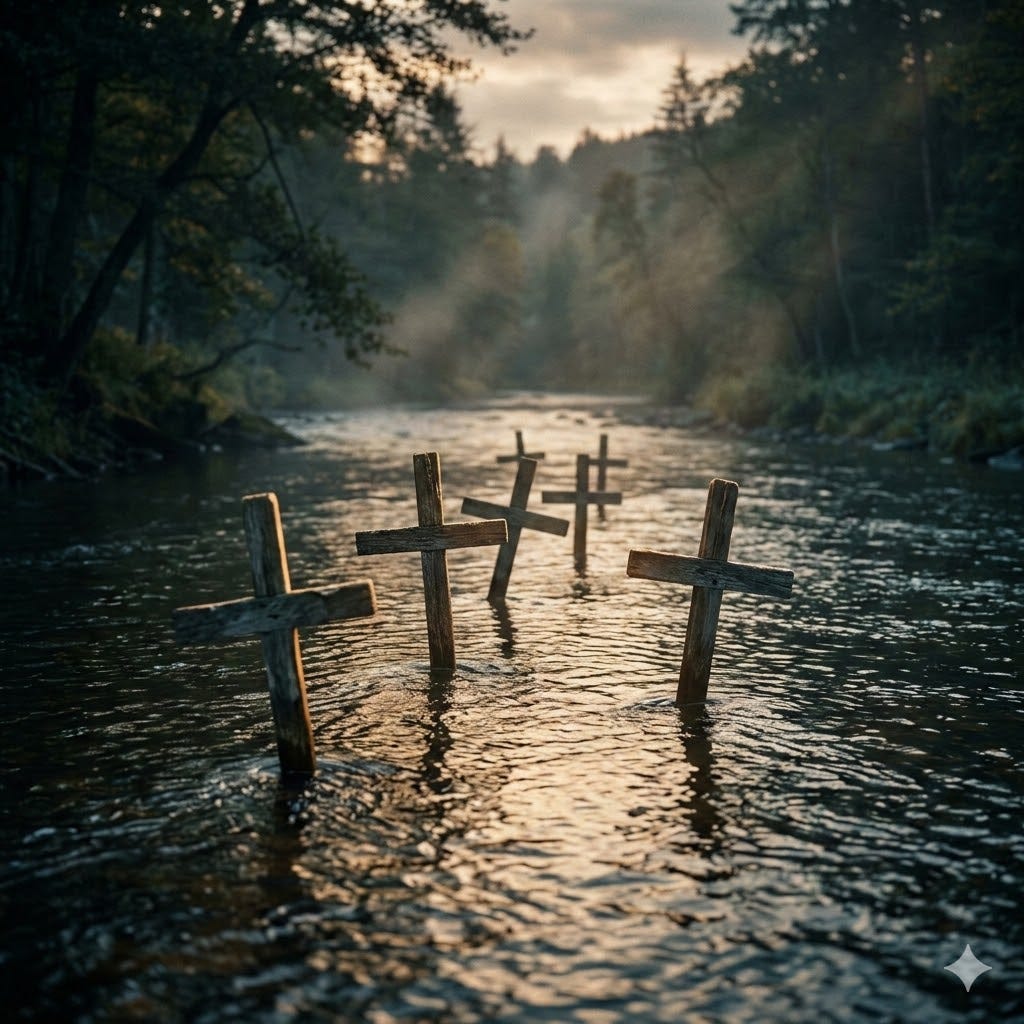
Sorrow is a river without a trout.
Sorrow is a river without a canopy of willows, old spruce, or cottonwoods, shading the water, gluing the banks together, and adding physical complexity to the channel.
Sorrow is a lack of a wide, vegetated riparian buffer to temper, trap, and treat the things we do to water before it gets to the river.
Sorrow is no intact forest in a river’s watershed to capture, store, and slowly release water, creating a reliable flow, and moderating both floods and drought.
Sorrow is water that is too warm, too muddy, and too contaminated to drink from a river freely or offer fish safe habitats.
Sorrow is a river without a trout and the loss of a signal that could have alerted us to a need for change.
Sorrow is for change that never happened, for learning that never occurred, and for the greed, ignorance, and inaction that still rob rivers of trout.
As we ratchet up our growth expectations, continue on unsustainable pathways, and fail to adhere to ecological limits, biologists will warn us of the implications. For many biologists, the losses of wild creatures and their habitats can reach a point where one wonders if there is a limit to grieving, a point beyond endurance, where no more sorrow can be absorbed. For those who don’t or won’t feel the pain of ecological grief, the implications to the natural world are disturbing.
Lorne Fitch is a Professional Biologist, a retired Fish and Wildlife Biologist and a former Adjunct Professor with the University of Calgary. He is the author of Streams of Consequence, Travels Up the Creek, and Conservation Confidential.
Thank you so much, Lorne. The sorrow for our watershed commons feels endless. This is not simply land—it is water, and water cannot be held in fee simple. All who dwell within it should have a meaningful voice in how it is governed. Thank you for holding up the memory of its degradation so we know what we must aim to restore.
So beautiful Lorne. Tears in my eyes. My sorrow and fear encompasses all the wildlife but especially the Rocky Mountain Bluebirds I monitor on the Eastern Slopes. All these factors are against them too, and against us all.