
Lorne Fitch, P. Biol.
A grader had already ripped up a linear section of the native grassland on the Antelope Creek Ranch when Bob, the Ranch Manager, corralled the operator and asked what he was doing. “Building a new lease road to a proposed well site,” was the answer. When asked for the letter of authorization, the operator shrugged and replied, “I don’t know anything about the paper work. I just get paid for building roads.”
After Bob called me, I determined the company hadn’t even applied for the authorization, let alone been given the go ahead for construction. The Antelope Creek Ranch is a working ranch of about ten sections, set up initially to integrate and demonstrate ways of conserving native prairie and its biodiversity with livestock grazing and petroleum development. Building another road across the grassland, especially without permission, and adding to an already cumulative weight of development, did not fit with conservation objectives.
I ordered the company to cease and desist on road construction. I also pointed out that there would be no more petroleum development on the ranch, given their failure to adhere to the rules. The company wasn’t aware I didn’t have authority to do either.
You would have thought the energy security of the free world was at risk, given the company response. Since my role was biodiversity conservation, not energy development, I remained unmoved by the tirade. I suggested they first re-read the conservation plan for the ranch, of which they were a signatory, and then we might talk.
A meeting was arranged in their corporate headquarters in Calgary, an imposing downtown skyscraper. I was asked to wait, a standard intimidation technique. I browsed the oil patch magazines, thoughtfully arrayed on a table. One article caught my eye. I took the magazine into the boardroom, a cavernous affair with an immense oval table surrounded by leather chairs. Art, depicting oil derricks and other petroleum related works set against scenes of tranquil and wild landscapes, surrounded the room.
Every chair was filled but one, with grim-faced executives. It was to be the inquisition of the lone biologist. I began by quickly reiterating the goals and objectives of the ranch, especially the integration of petroleum activity with wildlife conservation. I then opened the magazine and asked if I could read them a corporate perspective on how one oil company was responding to those challenges.
I don’t remember precisely how the piece was worded but it included references to environmental sustainability, of the necessity to plan accordingly, and to commitments for reclamation and restoration. It talked about working cooperatively with local communities and groups, the corporate responsibilities to adhere to government policy and regulations, and to going the extra mile to be seen as engaged and good corporate citizens wherever they worked.
I asked them if they agreed with this corporate prospectus. All nodded. I then asked them whether they knew which company was referred to in the article. None did.
I pointed out the article referenced their company, their corporate objectives, their corporate commitments, and their corporate philosophy. The inquisition was turned on its head and there was much coughing, sputtering, and twisting in leather chairs. Their corporate actions on the Antelope Creek Ranch were 180˚ from where their stated philosophy was located.
This isn’t an anomaly, a one-off from one company, an excuse lower levels didn’t get the “memo.” No, this is corporate spin to cover what is in practice, a lie. Fine words, meant to soothe, to placate, and to disguise from true intents, are epidemic.
The Alberta Forests Products Association, the lobby group for the timber industry, says their environmental mandate is: “Healthy forests help maintain a healthy environment, and we make sure the forest industry does too. The health of trees, plants, animals, air, water and soils—today and in the future—drives what our industry does and how we do it.”
One of the companies active in the Eastern Slopes provided this response: “We agree that understanding cumulative disturbance across ownerships is important and West Fraser will continue to utilize best management practices, low risk watercourse crossings and temporary roads to minimize our footprint.”
Actions speak louder than words and in an assessment of logging practices in the upper Oldman watershed, the Alberta Wilderness Association documented a complete failure on the part of West Fraser to “maintain a healthy environment,” “use of best management practices,” and to employ “low risk water crossings.”
Riparian buffers were logged over, erosion protection at stream crossings was generally either missing, poorly installed, or not maintained. Subsequent monitoring showed excessive erosion and sediment delivery from logging roads to streams containing threatened cutthroat trout and bull trout.
The findings of 667 failures to adhere to even the minimal timber harvest operating ground rules, the Fisheries Act and the Species At Risk Act would suggest the reality on the ground is a complete swap for the rhetoric of sustainable logging practices and protection of other forest values like species at risk trout.
Given the evidence, what drives the logging industry isn’t the narrative of a healthy environment, but a profit-driven one, to the exclusion of most of the essential ecological checks and balances to logging activity.
The Coal Association of Canada says, “Canadian coal operates under the world’s strictest environmental regulations.” Given the evidence that every open-pit coal mine in Alberta has had, and many continue to have acute, chronic, and catastrophic failures that impact water quality and biodiversity, this might suggest either the regulations and standards are hardly strict, hardly enforceable, or hardly enforced.
Hitchens’s razor is a general rule for rejecting certain claims of knowledge. It states: “What can be asserted without evidence can also be dismissed without evidence.” No facts are in place that detail the various environmental regulations on a worldwide basis as an opportunity to test the assumption Canada’s (or Alberta’s) regulations are superior. Nor does it offer evidence that regulations are uniformly followed.
Since the Coal Association, as the lobby group for coal interests, constantly lobbies both provincial and federal governments on reducing the environmental regulatory “burden,” one has to take the statement on operating “under the world’s strictest environmental regulations” with more than a pinch of salt.
In the case of coal mining, the evidence of environmental failures is voluminous, unequivocal, and compelling. The impacts of legacy coal mines, in terms of a constant release of a chemical stew of contaminants into receiving waters, selenium especially, is not a credible endorsement for the industry or its claims of environmental excellence.
It is as if corporate speak is designed to paint a picture that is a lie, make it a big lie, and tell it frequently enough so it will be believed by some, especially politicians who continue to support unsustainable logging, mining, and petroleum extraction practices.
The truth is painful, unpalatable, and politically dangerous, at least in the short term. In contrast lying is profitable (at least to some) and allows the powerful to set the narrative. To the lazy and the uninformed these lies seem practical and easy, even beneficial. But as José N. Harris, an American author, reflected, “Lies only strengthen our defects. They don’t teach anything, help anything, fix anything or cure anything. Nor do they develop one’s character, one’s mind, one’s heart or one’s soul.” That works at a corporate level as well as at a personal one.
When many understand they are being lied to, they start to look under the surface and find the cracks in corporate speak. If the social license to operate is lost, credibility and trust fly. The regulatory one may be soon to follow. Then corporate aspirations diminish.
Children are taught that the ethical principle is to tell the truth at all times. Yet in politics and business it seems this is a common transgression. Some lies are made in apparent error, because of failures to investigate all the evidence. But lies by intention, when the truth is known and the facts are indisputable, should be considered the most serious of crimes.
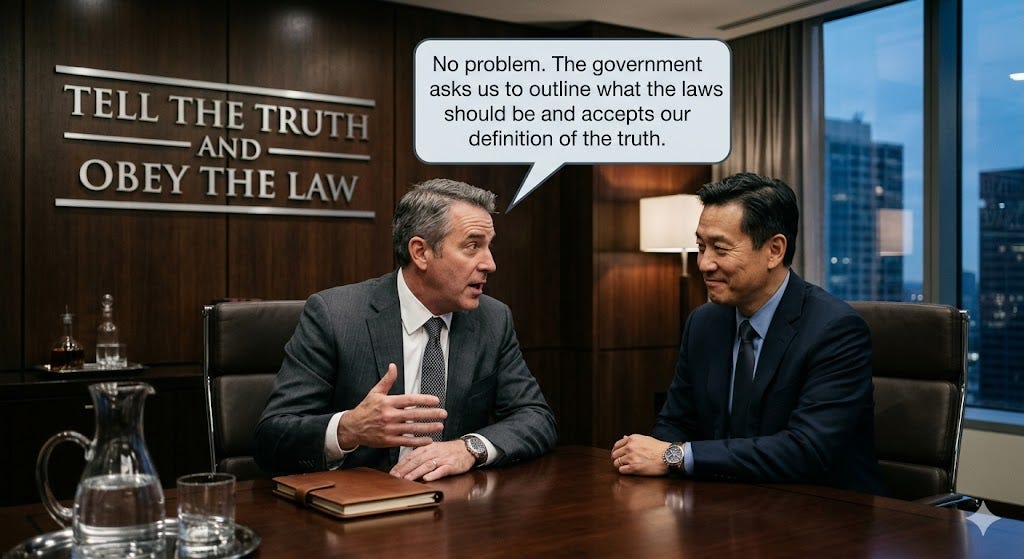
When Jack Ward Thomas, an eminent wildlife biologist, took over the helm of the US Forest Service, he sent a short, but pointed memo out to all staff. It read, “Tell the truth and obey the law.” Imagine if this was to be the new corporate mantra.
Lorne Fitch is a Professional Biologist, a retired Fish and Wildlife Biologist and a former Adjunct Professor with the University of Calgary. He is the author of Streams of Consequence, Travels Up the Creek, and Conservation Confidential.
Absolutely right on the mark Lorne, Great insightful article. The problem s how to get the resource industries to recognize the importance of sustainability in their developments as opposed to their Growth for greed model that encourages them to keep cheating us of our needed essential biodiversity in our wilderness? Keep up the great writng. Cheers, Darrel
Another “mindblowing peice “ by biologist and superlative writer and teller of non-fictional (truth life) events.
KUDOS to Lorne Fitch once again!