
Why Conservation Makes Me Mad and Motivated
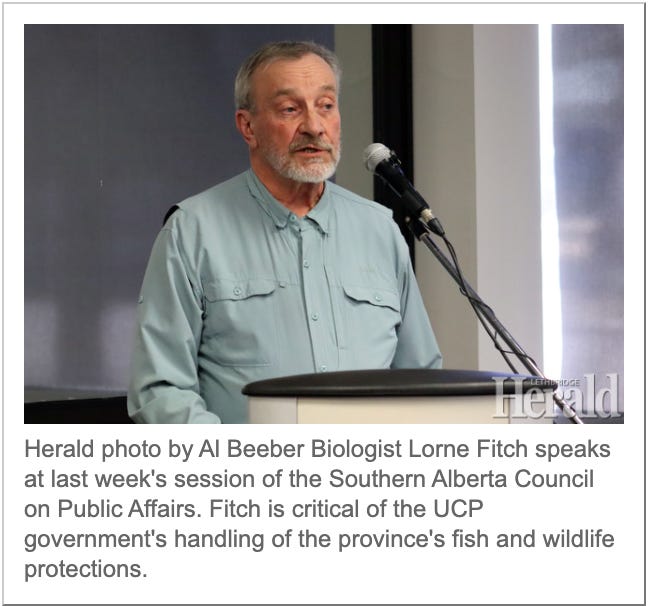
Lorne Fitch, P. Biol.
Setbacks in conservation and environmental protection are legion. It feels like the economic and political weight of the world is arrayed against me in rigged deals, unequal footings, and unfair processes. Population pressures, consumer demands, and economic growth seem insatiable and irresistible. Conservation successes are few, infrequent, and ephemeral. But failure is not an option.
One of the contradictions of our lives is we see ourselves as living on the land but not the land living in us. As such, the linkages are broken, severed even, and do not serve to inform our conscious lives about these essential connections.
We have forgotten that within the land is power and life, origins and futures, foundations and walls, humility and promise, and myth and story. When we lose that sacred bond to place we become untethered through ignorance, greed, and even malice. When we break the land, pollute it, corrupt it, shifting it to just another commodity to be used up and discarded, we are doing the same thing to ourselves. What some term progress can eat away at a landscape as leprosy does to a nose.
There is a tendency to default to “taking the world as it is.” This was recently articulated by our Prime Minister in response to world affairs. Carrying this forward to the relentless economic development impacting the natural world, the conclusion would seem to be to give up hope on biodiversity, on ecosystem strength and resilience, on combating climate change, pollution, and land degradation. Perhaps in the minds (and actions) of politicians and corporate giants these might be considered only aspirational goals.
However, aspirations lead to awareness, it leads to concerns, concerns are a link to action, and action takes us into the realm of the possible. Then, instead of blind acceptance we view the world, not as it is, but as it should and could be.
When I see the unwarranted delays or reversals in environmental protection I formulate a question. I ask this of politicians and economists, corporate executives, and the apologists and cheerleaders of unbridled economic growth— have they ever calculated the number of species and their habitats that must be condemned to extirpation, degradation, irrelevance, and death to produce one more vote, one more stock dividend, and one more rich person in a land made poor because of a single-minded pursuit of wealth?
Where in the balance sheets of the Sirens of economics are recorded the costs of being rich—the frequency and intensity of floods, drought, wildfires, air quality alerts, heat domes, and the other wicked weather linked economic development? Or the losses of biodiversity, water and air quality declines, soil loss, and reduced landscape resilience to changes brought on by getting rich.
Most governments spend more on subsidies that destroy biodiversity than they do on financing conservation. If much of that money was redirected from supporting fossil fuel extraction, destructive mining, harmful agriculture and logging, the perversity of making our world less habitable through public tax dollars would decline and conservation efforts would be better funded.
It is human nature to reject evidence that doesn’t support our opinions. Although we are all entitled to our opinions, it doesn’t mean we get to make up our own facts. However, the strategy employed by those unmoved by facts, the uncomfortable truths, follows a time-tested pattern. Disparage the science, attack the scientists, make outrageous statements, including the invoking of conspiracy theory, and manipulate and use only the information that seems to support your side.
Science serves everyone, but only if we choose to listen. Facts don’t cease to exist because we won’t accept them, or worse still, ignore them. Science doesn’t give you the answer you want, it provides the result the evidence indicates.
Muting science to make the compromises orchestrated by governments, businesses, and ourselves is a testament to something—let’s make a deal where everyone is a bit unhappy. A standard level of unhappiness by all seems to signal success in negotiation. In the give and take between the environment and economics there is a lot more give expected from the environment and much more take anticipated from the economic side.
Such compromises epitomize our everyday world thinking but rarely does the evidence shore up the result. For example, not imposing a realistic carbon emissions target that actually slows climate change, putting faith in an unproven carbon capture technology, while ramping up oil production, and pushing any reconciliation with the evidence far into the future, may well ensure we don’t have a future. The contention that accelerated economic growth can be aligned with environmental protection is a pernicious myth.
Disconnection—the tendency of ignoring the evidence to connect the dots to the erosion of earth’s systems— allows ecological abuse to continue, regulatory blindless to persist, lies to compound the damage, and the surrender of us all to greed, corruption, inequities, and fantasies.
Some of us wonder where and when change will occur. Shifts in attitudes and behaviours with awareness of options can help. But often the sense is that individual actions are cancelled out by government and business to inaction or contradictory actions. It seems that the motivation to change, to act, only comes when we are teetering on the edge of an abyss. Then all the previous alarmist calls become real and compelling at about the same time there is a realisation our options are limited or precluded.
If we viewed climate change and everything associated with it—fire, flood, drought, wicked weather, death, famine, and extinctions—like a world-wide plague (which in all respects it is), or an asteroid on an impending collision course with earth (with past precedent), we might have a sense of urgency about the need to change, shift, and adapt in time.
Some won’t recognize the urgency because in their minds the evidence isn’t compelling, or there is the ever present illusion we will dodge all of this with yet unknown, untested technology. To some, explanations of the nuances, intricacies, and outcomes of scientific research can often sound made up, unbelievable, and even stupid—not airtight like biblical references, an economic development prospectus, or a government news release.
Others will simply party on because if we are going out with a bang, so be it. For many of us the status quo is hard to avoid—it seems so comfortable and safe. We’re in a rut, but it’s carpeted and well furnished. It’s easier to watch Netflix than a documentary on biodiversity loss.
Essentials like air, water, soil, and biodiversity are a common good. They need to be commonly protected. If they are not, then the suffering includes all of us, everywhere. The rich might think they have lifeboats, but those will be rendered useless if there’s no water or safe harbour. The concept of wealth needs a reboot, to remind us what is essential to our survival.
In matters of the environment it is not enough to be aware. It is not enough to be concerned or anxious. It is not enough to be angry. Feeling helpless, powerless, or resentful, and that failure is inevitable is self-defeating. We must resist the urge to acquiesce, to surrender, to give up. Now is not the time to sit on our hands, or passively wring them—it’s time to raise a hand.
Passively accepting ecological losses is to assent to the system responsible for the destruction, and to become part of it. Resist when government and corporations try to convince you otherwise. If those who destroy ecosystems feel no consequences for their actions, nothing will change.
Resistance and change happen in dialogue, in conversations. These are facilitated, and delivered through the art of words conveying feelings. Issues are complex. People hear fragments and from those fragments it’s difficult to grasp the bigger picture. Shared understanding needs to be built with an ecological education.
This can only happen with trusted relationships in neutral settings where there is a sharing of ideas and concepts with lots of listening. This should be occurring at all levels of government, but isn’t.
Each generation must commit to protect wild places, processes, and things, and not give way. This will require a fundamental shift in our thinking and approach to Earth’s gifts. We spend our lives in pursuit of what we want and in denial of what we need. An essential move is to a better accounting of the essentials of life that cannot be bought but are easily destroyed.
Wind and water eventually wear away stone. Persistence is the handmaiden of resistance and the ultimate solution for conservation.
Lorne Fitch is a Professional Biologist, a retired Fish and Wildlife Biologist and a former Adjunct Professor with the University of Calgary. He is the author of Streams of Consequence, Travels Up the Creek, and Conservation Confidential.
One can’t eat, drink or breathe money!
It’s pretty easy to understand.
This earth doesn’t need us, rather we need it.
I don’t know what it will take to make humans understand this and then take action accordingly.
Thank you Lorne Fitch for continuing to educate us and continue to make a case for this planet.
Thanks Lorne!