
Twenty Reasons for Conservation Concerns
Lorne Fitch, P. Biol.
How many reasons are there to be concerned about the pathway of conservation in Alberta? Let us count some of them.
The questionable axing of many long-standing conservation initiatives in Alberta (e.g. Alberta Water Council, Alberta Clean Air Strategic Alliance) and the drying up of operational funding for other non-government initiatives by the UCP government.
The failure of the UCP to fund internal departmental environmental monitoring and research, especially on critical issues related to water quality, species at risk recovery, and work on climate change.
The chicanery of the UCP related to decisions about coal mining in the Eastern Slopes, especially to allow the zombie Grassy Mountain mine to be revived with new coal exploration. This despite the opposition of the majority of Albertans to coal mining.
Since 2022 five independently reviewed scientific papers have demonstrated the extensive, pervasive, lingering, and damaging negative impacts of coal mining in Alberta.
A decision by the CEO of the Alberta Energy Regulator (AER) to forgo a scheduled public hearing on Mine 14 near Grande Cache and to provide regulatory approvals for the mine after an apparent political intervention by the mine owner. Similarly, the AER has approved expansion of the Vista coal mine near Hinton, again without a regulatory hearing or an environmental impact assessment.
Another “unfettered” decision by the AER to secretly change the rules to limit who is “directly affected” by developments and preclude public participation in hearings.
The “failure” of the Water Not Coal petition to make it through the impossible and suspect hurdles of the Elections Alberta statistics labyrinth. Over 200,000 Albertans signed the petition in good faith.
To counter the federal government’s “A Force of Nature,” a strategy to extend landscape protection nationally, the UCP erroneously contend 60 per cent of Alberta is already “protected.”
Regional planning efforts for entire watersheds have stalled in Alberta, with no broad-based, long-term perspective to define land use outcomes, in the public interest. Instead, subregional planning for the Upper Smoky, Red Earth, and the Caribou Mountains follows the dictates of industry to maximize short-term economic activity at the expense of watershed protection, biodiversity concerns, cumulative effects, ecological thresholds, and recreation.
Building commercial resort developments in provincial parks is now permitted, despite impacts on water, biodiversity, and other recreational pursuits. It is doubtful most Albertans will be able to afford to stay in such upscale developments.
The inability of regulatory agencies in Alberta to exert even minimal enforcement of guidelines for logging in Eastern Slopes forest watersheds which harbour species at risk trout and are the water supply for most Albertans. Sustainable forest management has been perverted to maximum timber harvest.
An obviously illegal logging bridge constructed over the Highwood River in critical habitat for bull trout was ordered removed by the Department of Fisheries and Oceans (DFO), yet no charges were laid under the Species At Risk Act. DFO has subsequently permitted the construction of another bridge at the same location.
Instead of following the “avoidance” principle, provided in DFO guidelines for species at risk trout protection, the department is instead issuing permits to the logging industry to destroy critical trout habitat, as long as there are “offsets” to compensate for the loss. No evidence or monitoring is provided to validate the effectiveness of such decisions.
There is a rollback of federal legislation and weakening of the Fisheries Act, the Species at Risk Act, and other environmental guardrails to facilitate “accelerated economic development.”
Wildlife management changes are more to benefit commercial interests than to provide recreational benefits to Albertans or for conservation objectives.
Irrigation expansion fever dreams, including multiple proposed new onstream dams (5) and several off stream reservoirs (4) at mind-blowing financial and environmental costs. This is leading us, inexorably to “water bankruptcy.”
Several AI data centres proceeding with essentially no environmental oversight despite real concerns over water availability, power consumption, cumulative effects, and effluent releases.
A complete antipathy on the part of the UCP government to renewable energy, a clear pathway to coping with climate change.
Despite the evidence linking burning fossil fuels and climate change, leading to greater incidences of wicked weather, wildfires, drought, flooding, heat domes, and health risks, Alberta continues to push for more oil and gas extraction. Connecting the evident dots seems insurmountably difficult.
There is the wildly improbable fig leaf of carbon capture and underground storage, a politician’s wet dream to evade the reality of exacerbating climate change from expanding petroleum extraction and combustion.
One doesn’t need much insight or analysis to conclude conservation, the protection of our natural environment, is not a priority in Alberta. You don’t even need to be much of a conspiracy theorist. In fact, the evidence points to a concerted effort to thwart conservation efforts, even to contend they are unnecessary and impede economic development.
Evidence to the contrary, that we are quickly sacrificing our wild heritage and the ecosystem attributes contributing to our well-being, is dismissed out of hand. A resource extraction and development mantra is deafening. Subsidies, perks, incentives, and political support for economic development are running rampant, while conservation efforts, environmental protection, research, and monitoring are starved of funding.
Failure to protect, conserve, and steward our natural assets is like running blindly with scissors. It is racing to an obvious hurtful fall for all of us, which is completely avoidable.
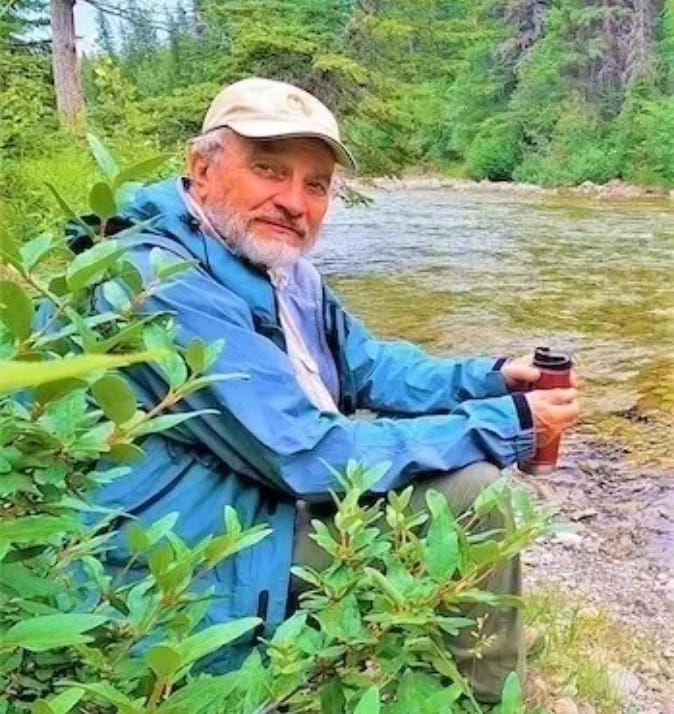
Lorne Fitch is a Professional Biologist, a retired Fish and Wildlife Biologist and a past Adjunct Professor with the University of Calgary. He is the author of Streams of Consequence, Travels Up the Creek, and Conservation Confidential
Quality of life in Alberta is intentionally being destroyed to further enrich UCP donors and foreign billionaires. The UCP hates Albertan’s. We see it daily. We in fact are paying for the psychological and physical abuse paying the salaries of our abusers..
Everyone interested in the future of our province needs to get their heads out of the sand and open their eyes to the obvious. Alberta's wild mountain country is in the process of being torn apart, for the interests of forestry and fossil fuel extraction, interests that are more often than not those of foreign corporations........often American based.
When Trump speculated on Canada becoming the 51st state, he was talking about Alberta.....and possibly our north country. From what the UCP are doing and refusing to do, it looks to me like the Americans are going to have us.........without the bother of a military border crossing.
Danielle Smith and the UCP will work hand in glove with well heeled heels to turn us into a sacrifice zone of resource development.........forgetting, as have parts of the Middle East, that you can only last 3 days without water.